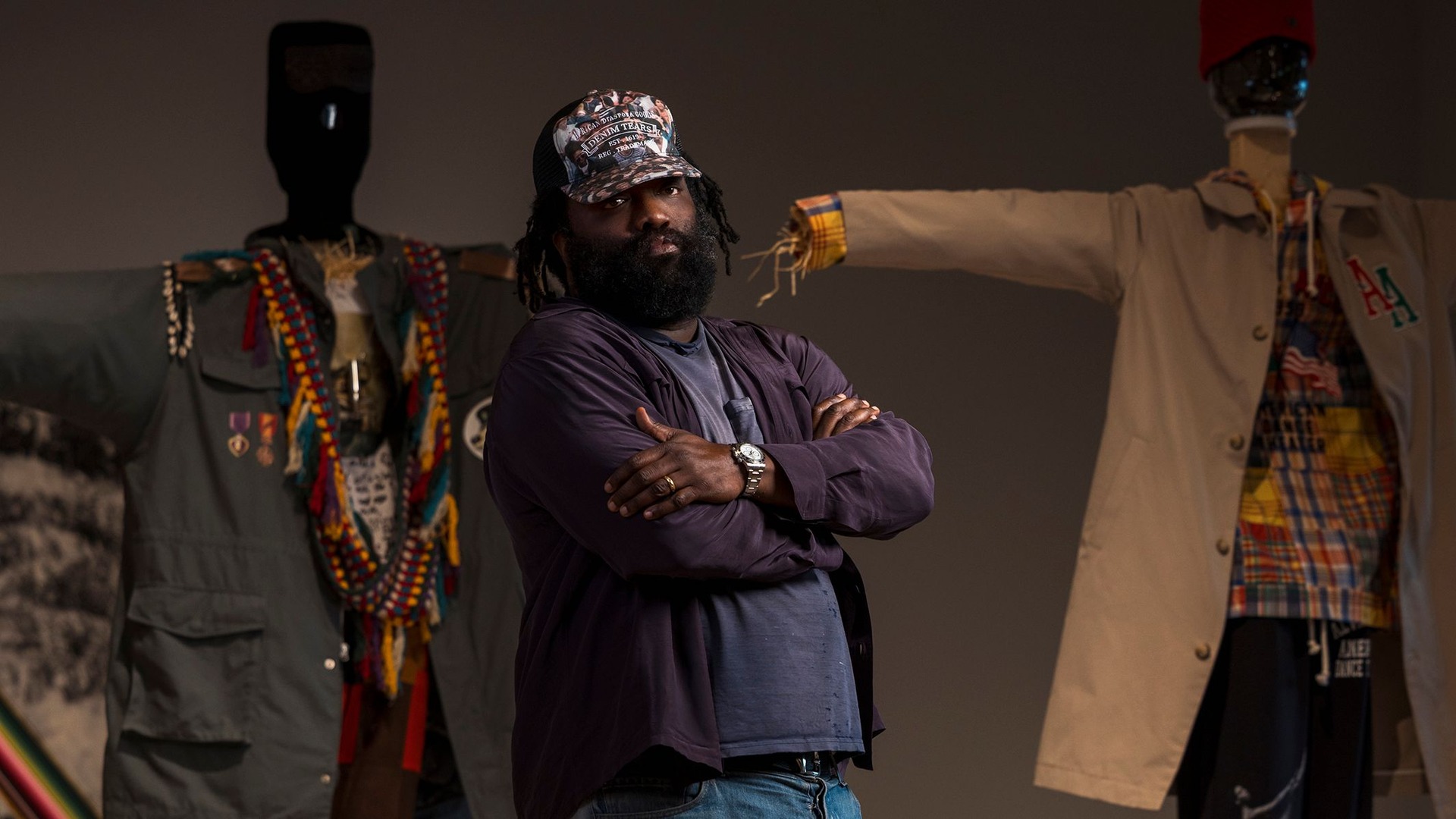
Tremaine Emory has spent a decade making clothes that refuse to stay only clothes—and this week the museum record caught up. Writing for Vogue on 18 September 2026, Max Berlinger reports that the SCAD Museum of Art opened “Denim Tears From the Pool of Black Genius,” the first solo exhibition and retrospective dedicated to Emory and his sprawling creative practice. The show places Emory’s pieces beside works by artists who inspired him—among them Arthur Jafa, Hank Willis Thomas, and David Hammons—and runs through 11 January 2027. For Cover Issue’s culture desk, this is the fashion×museum story of the week that is not another runway recap: denim as historical text, streetwear as educational pathway, and a designer whose collaborations with Dior, Levi’s, Ugg, and the late Virgil Abloh always pointed beyond the drop calendar.
Berlinger opens with Emory’s pre-label imprint—creative consulting for Stüssy, Marc Jacobs, Yeezy—before Denim Tears, a short Supreme creative-director chapter, and a practice that engages race and politics without reducing garments to slogans. Denim Tears launched in 2019, four hundred years after the first known enslaved Africans arrived in America; the name, Berlinger writes, refers to cotton—the textile around which slavery was built—and to the pain Black people endured to harvest it. That etymology is the exhibition’s moral architecture. Stay inside Vogue’s sourced account; Cover Issue does not invent additional manifesto lines, private studio quotes, or unsourced controversy.
What the SCAD show actually stages
Berlinger describes a curation that underscores the breadth of Emory’s references and the fact that his fashion output was always designed to be in conversation with culture at large. Through graphic T-shirts, embellished jeans, workwear-style jackets, and other garments and accessories, Emory nods to history and cultural memory. A museum release, as Vogue quotes it, says his work “transforms important historical references into contemporary objects and experiences” and “creates educational pathways between Black history and the history of clothing.” In challenging established hierarchies and encouraging dialogue, Emory positions fashion as both conceptual art and a tool for reflection and education.
That museum language matters for how Cover Issue files the piece under CULTURE rather than pure RUNWAY. This is not a seasonless lookbook flip—it is a retrospective argument that jeans, cotton wreaths, and slogan tees can sit beside Jafa, Hammons, and Hank Willis Thomas without apology. Vogue’s slideshow, photographed by Aman Shakya and shared with SCAD, gives readers exclusive exhibition images; Cover Issue’s cover photograph for this article is a real editorial frame of Emory in that museum conversation, not a flat graphic poster.
Collaborations as cultural method, not hype cycles
Berlinger’s curriculum vitae for Emory is also a map of how contemporary fashion absorbs Black conceptual practice: Dior, Levi’s, Ugg, David Hammons, Virgil Abloh, a Supreme interim. Read those names as evidence of range—luxury, Americana workwear, artist collaboration, streetwear institutions—not as a shopping checklist. The SCAD show’s value is that it freezes the practice long enough for viewers to see the through-line: cotton, denim, memory, education. Attribute every biographical beat to Berlinger’s 18 September 2026 Vogue report.
How to visit the idea if you cannot get to Savannah
Even readers who will not walk the SCAD galleries before January 2027 can use Berlinger’s frame as a viewing guide for Emory’s clothes in the wild. Look for historical references translated into wearable objects; for denim treated as archive rather than only trend fabric; for graphics that teach rather than only flex. Those tells are editorial observations grounded in Vogue and the museum release Vogue quotes—not Cover Issue inventing a wholesale theory of streetwear. Pair the exhibition news with the simple calendar fact Berlinger supplies: on view through 11 January 2027.
How this CULTURE slot differs from Homme Plissé × Tate
Cover Issue’s earlier Homme Plissé Issey Miyake × Tate Matisse capsule was fashion animating a European modernist cut-out inside a London museum tank. Emory × SCAD is a different museum grammar: a Black American designer’s retrospective staged beside the artists who shaped him, with cotton and denim as historical materials rather than pleated colour blocks. Both are fashion×culture; neither duplicates the other. Keep the distinction clean when internal linking—Matisse snails for pleats, Pool of Black Genius for denim memory.
Watch how “Denim Tears From the Pool of Black Genius” travels beyond Savannah—whether museum retrospectives become a more common endgame for streetwear founders, and whether Emory’s educational-pathway language reshapes how luxury collaborators talk about cotton. For now, the sourced Vogue record is clear: Tremaine Emory’s first solo museum show treats fashion as conceptual art without abandoning the jeans that made the argument wearable.
Denim as archive fabric in a museum decade
Berlinger’s reminder that Denim Tears launched on a four-hundred-year anniversary is not trivia—it is why a Savannah museum can hang jeans next to Arthur Jafa without the pairing feeling like a sponsorship stunt. Cotton and denim carry forced labour history in their fibres; Emory’s project, as Vogue frames it, keeps that history visible while still making garments people wear on sidewalks. Readers who only know the brand from a single Levi’s or Ugg drop can use the SCAD retrospective as a syllabus: start with the name’s etymology, then look for how embellished jeans and graphic tees translate historical reference into contemporary object, exactly as the museum release Vogue quotes describes.
What “Pool of Black Genius” signals in the title
The exhibition title itself, as Berlinger records it—Denim Tears From the Pool of Black Genius—positions Emory inside a lineage rather than above it. Staging his work beside Hammons, Jafa, and Hank Willis Thomas makes the lineage literal on the gallery wall. Cover Issue’s culture reading stays with that curatorial fact. We do not invent ranking dramas between the artists, nor do we reduce Emory’s fashion to a footnote of the artworks beside it. The point of the show, per Vogue, is conversation: fashion as conceptual art and educational tool at once.
Practical culture-desk follow-through
For Cover Issue’s hourly desk, Emory × SCAD is the CULTURE slot that keeps the site from becoming runway-only during London Fashion Week. It gives India-and-US readers a Black American fashion-museum story with a clear end date (11 January 2027), a clear city (Savannah via SCAD Museum of Art), and a clear primary source (Berlinger / Vogue / Aman Shakya exhibition images). Internal links can point curious readers toward earlier Cover Issue culture pieces on museum capsules without duplicating Homme Plissé × Tate’s Matisse angle.
Do not invent attendance figures, collector prices, or private remarks Emory did not give Berlinger. The published record is enough to argue that denim-as-memory has entered the museum calendar in a lasting way—and that Tremaine Emory’s first solo retrospective is the fashion-culture headline worth filing on 20 September 2026.