Schiaparelli: Fashion Becomes Art at the V&A is the UK's first major museum survey spanning Elsa Schiaparelli's 1920s breakthroughs through Daniel Roseberry's contemporary couture. According to the Victoria and Albert Museum's exhibition page, the show runs in the Sainsbury Gallery at V&A South Kensington and closes Sunday 8 November 2026, with weekday and weekend ticketing. British Vogue's Hamish Bowles, publishing 26 March 2026, walks the rooms curator Sonnet Stanfill built—reveals, arcs of embroidered jackets, perfume cabinets, and garments too fragile to travel for Andrew Bolton's earlier Impossible Conversations show. For Cover Issue's culture desk, Schiaparelli V&A 2026 is fashion treated as art history without flattening Roseberry into a footnote or Elsa into a meme.
Entrance gallery: Place Vendôme, trompe l'oeil, newspaper print
Bowles opens where the exhibition opens: Schiap seated large as life in her 21 Place Vendôme salon, Colonne Vendôme visible through tall ruffled net curtains, walls tasting her 1935 newspaper print with Women's Wear Daily clippings of house innovations. A trio of sweaters knitted by Armenian women—trompe l'oeil scarves that first made her name—anchors the origin story. The V&A's own highlight list pairs that invention with later house icons and Roseberry-era couture photography, insisting the survey is continuum, not nostalgia vault.
Bones outside, Tears, Lobster: the Dalí axis
Bowles lingers on the dress made for actor Ruth Ford: black jersey sheath with padded bone formations based on Salvador Dalí sketches. Dalí wrote that he liked the idea of bones on the outside enormously, Bowles quotes. The garment is placed so visitors see the front, then later the padded back—possibly the last time it can be shown because of its delicate condition. Bolton had wanted it for the 2012 Schiaparelli and Prada Met conversation; fragility blocked the loan. Nearby, Bowles revisits the Tears dress and Lobster dress from the summer 1937 Dalí collaborations—ripped-fabric trompe l'oeil and the cooked lobster painted by silk designer Paul Sache—pieces also worn in the orbit of Wallis Simpson and photographed by Cecil Beaton. Cover Issue attributes those histories to Bowles and the V&A; we invent no new royal gossip.
Cocteau's double profile and the Lesage arc
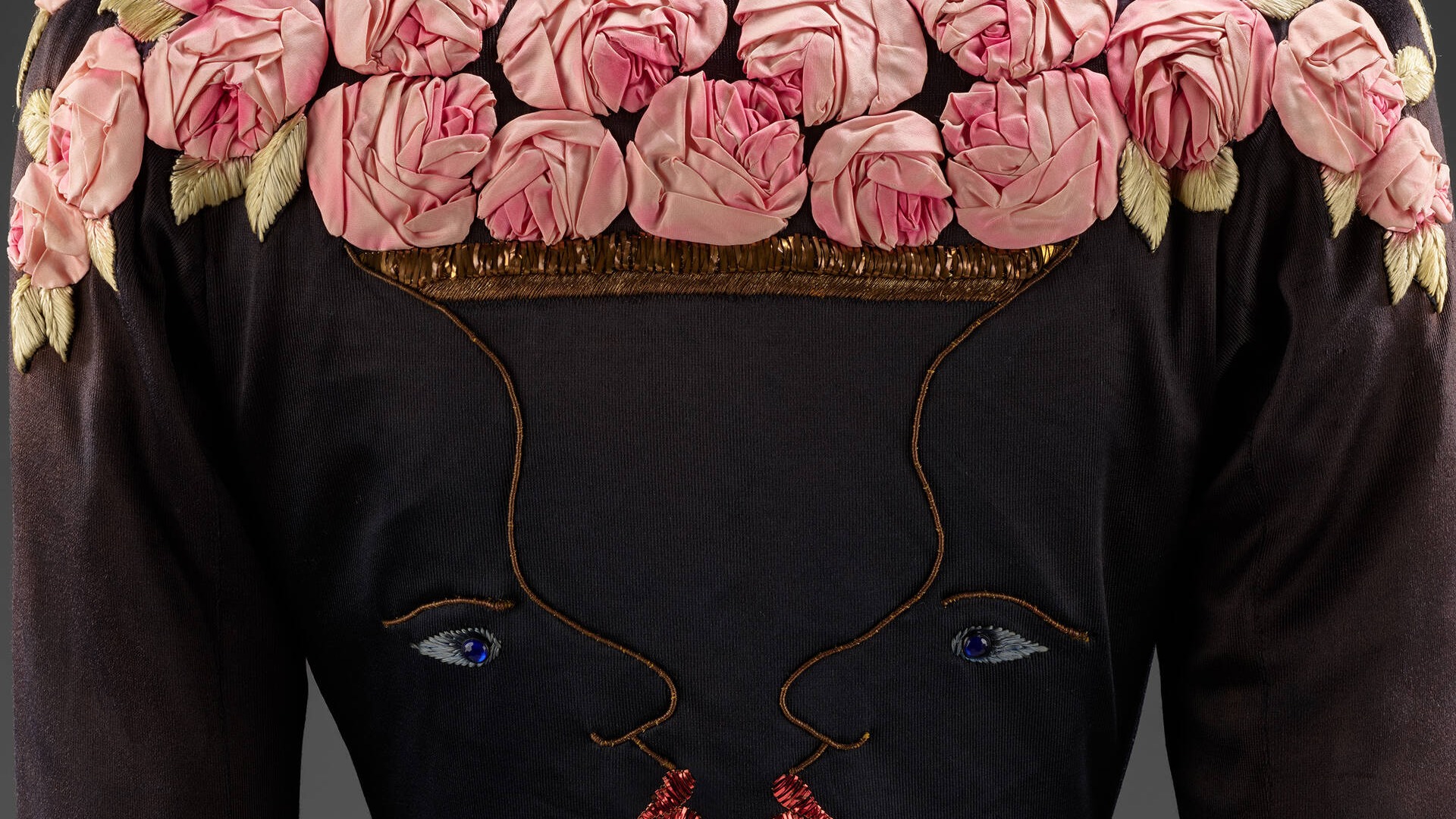
The evening coat embroidered so two heads meet in profile and form an urn, roses covering the shoulders, is based on a Jean Cocteau design and was worn by Doris Castlerosse, Bowles writes. That is the garment Cover Issue's cover photograph isolates from the V&A's collection photography—black ground, pink ribbon roses, metallic profile lines, blue bead eyes. An arc of embroidered jackets follows: Ruth Ford's Circus jacket with sequins and mirror bits; a blue chiffon Lesage waistcoat-style jacket with tambourine buttons; a spring 1947 black jacket with a whoosh of jet-embroidered Shocking Pink taffeta whose hard shoulder line Bowles contrasts with Dior's soft New Look the same season. Buttons, always essential to Schiap, get their own cabinet.
Picasso's Nusch, the shoe hat, and Shocking
Bowles celebrates Pablo Picasso's 1937 oil of Nusch Éluard in a Schiaparelli jacket with broad collar, twin figures on each lapel, trademark buttons, and a Schiap hat—finally credited in a fashion museum context after curators elsewhere gave him blank stares. The black shoe hat with Shocking Pink velvet heel, clamored for by Gala Dalí and Helena Rubinstein, sits in solitary state. Perfume rooms for Zut, Sleeping, and Shocking complete the sensory map. Related Cover Issue culture reading: Iris van Herpen's Brooklyn Museum Sculpting the Senses chapter at https://thecoverissue.com/iris-van-herpen-sculpting-the-senses-brooklyn-museum-2026 for another fashion-as-museum conversation—different century, same insistence that clothes hold ideas.
London salon, Maud Russell, and British clients
Bowles recounts Schiap opening at 6 Upper Grosvenor Street in 1934 after Britain taxed imported luxury silk—Didn't the Romans come and conquer Britain? she quipped. Evening dresses belonging to Maud Russell in bold orchidaceous florals, Frances Farquharson's mourning blacks, and Millicent Rogers's zippered camouflage dress and greige trouser suit thicken the British client story. The V&A framing matters: this is not a Paris-only myth; London was a working market.
Roseberry in living memory, Elsa in the vitrines
Bowles states plainly that Daniel Roseberry's extraordinary contemporary creations live in recent memory and answer for themselves; the essay's swoon focuses on Elsa's invention. The V&A exhibition page, however, markets both—house origins and evolution under the current creative director—so visitors should expect couture AW24 photography of models such as Awar Odhiang alongside Dalí telephones and Man Ray portraits. That dual brief is the culture story: a house still designing, a museum arguing dress designing can be an art, using Schiap's own line as epigraph.
How to visit before 8 November 2026
Advance booking is recommended; weekday tickets are listed around £28 and weekends £30 on the V&A page, with concessions. Cromwell Road, South Kensington, Sainsbury Gallery. Cover Issue is not a ticket reseller—check vam.ac.uk for current hours and access. Go for the Cocteau coat back, the Ford bones dress, the shoe hat, and the Lesage arc; leave with a clearer sense of why surrealism still underwrites modern couture shock.
Schiaparelli V&A 2026 does not need invented scandals. Bowles and the museum already supply enough astonishment. Read it beside Homme Plissé's Tate Matisse dialogue on Cover Issue if you want another fashion×institution pairing—then book the Sainsbury Gallery before the Shocking Pink exits stage left on 8 November.
What to notice in the jewellery and button rooms
Bowles flags Schiap's jewellery and button cabinets as essential, not side quests. Tambourine buttons, crushed porcelain roses, and Shocking Pink accents explain how small hardware carried house identity long before logo mania. Pair those rooms with the perfume corridor—Zut, Sleeping, Shocking—to understand how scent extended the surrealist joke beyond cloth.
Exhibition design as argument
Stanfill's reveals and arched sightlines, as Bowles describes them, teach visitors to look twice—Ford's bones dress front, then back. That museological pacing is why Schiaparelli V&A 2026 belongs in Cover Issue culture rather than a simple lookbook dump. Fashion becomes art when the museum forces slow looking. Visit before 8 November 2026; credit Bowles and the V&A; invent nothing.