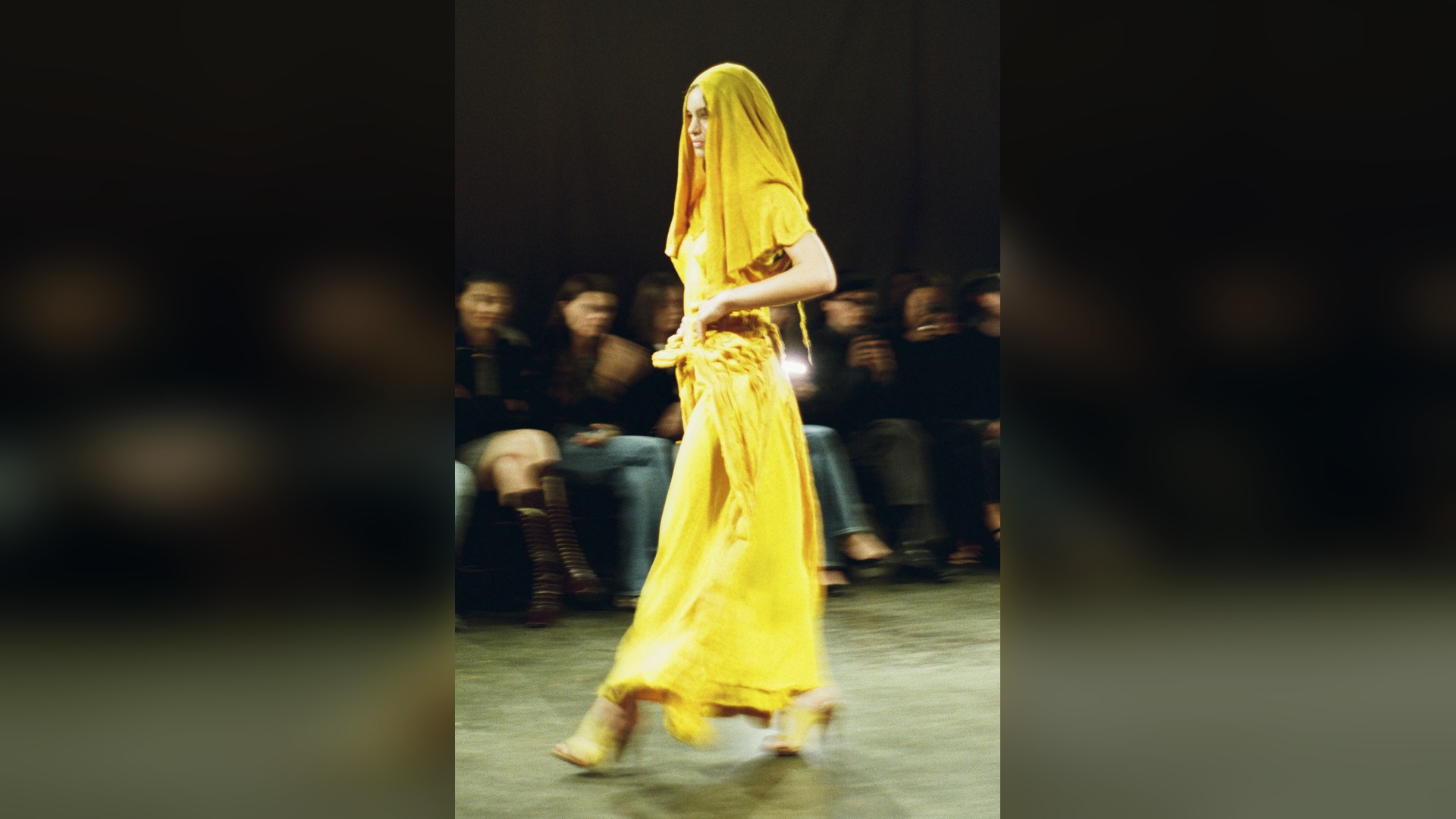
Paolo Carzana SS27 turned a sleepy Earls Court street into something closer to a Victorian horror premise than a conventional London Fashion Week slot. According to WWD’s Lily Templeton, writing on 20 September 2026, the Welsh designer staged Spring/Summer 2027 inside a darkened church whose walls were obscured by long panels of canvas—Saint Cuthbert’s, a listed nineteenth-century church prized for its Arts and Crafts decor. Models, Templeton writes, looked like shrouded statues coming to life. For Cover Issue’s runway desk, Carzana’s St Cuthbert’s show is the clearest LFW argument this week that venue, cloth, and commercial question marks can share one room without inventing scandal.
Desireo’s Gabriella Anastasia, reporting the same presentation, places the evening on 18 September and notes a finish around 10:30 p.m., with white fabric shrouding the interior and models appearing outside the church afterward as a public-facing finale. Read Templeton for the sculptural cloth language and the open commercial question; read Desireo for chronology, after-hours timing, and the exterior coda. Stay inside those two sourced accounts—do not invent look counts, wholesale figures, or private drama.
Canvas shrouds, Arts and Crafts stone, and the philosophy of absence
Templeton’s scene-setting is deliberately atmospheric: almost no one on the Earls Court street; a darkened church; canvas panels hiding the walls. Completing the impression, she writes, was Carzana’s lineup itself. Desireo deepens the curatorial paradox: while St Cuthbert’s exterior offered expected gothic grandeur, Carzana shrouded structural features in white fabric, creating a minimalist interior that stood against ornate stone and stained glass. By blocking the building’s intrinsic beauty, Desireo argues, the designer forced focused engagement with garments—beauty appreciated through absence and revelation.
That site-specific instinct sits cleanly beside Featured Mulberry at Three and Roksanda SS27’s daywear braid chapter: same city week, different craft registers. Mulberry holds heritage leather narrative; Roksanda holds François Grossen braiding on day-to-evening separates; Carzana holds canvas-shrouded church as emotional architecture for shredded cloth.
Shredded filmy knits, fraying seams, and Murillo’s ordinary people
As is his wont, Templeton reports, Carzana sent superpositions of shredded filmy knits, barely-there woven textiles, and fraying seams that curved and stretched against the human form. Here and there, openings gave flashes of an inner thigh or the curve of a hip. One could argue, she writes, that the work harkened to a rich strand of European painting from the sixteenth and seventeenth centuries, where artists such as Spain’s Bartolomé Esteban Murillo made ordinary people subjects in their own right rather than background characters to portraits of the powerful. Attribute every textile description, body flash, and Murillo analogy to Templeton / WWD; Cover Issue does not invent additional painterly citations.
Desireo frames the same DNA as tiered fabrics, deliberate distressing, knotting, and intricate draping—executed, the outlet notes, with a new refinement that suggests technical maturation. Where earlier seasons read more conceptual, Desireo sees wearable fluidity bridging avant-garde runway and high-end retail consumption. That wearability claim is Desireo’s editorial judgment; Templeton’s closing line is cooler. Keep both attributions clear.
Handcraft, sculptural imagery, and commercial viability “shrouded in mystery”
Templeton’s verdict is the headline Spine of this piece: there were great amounts of handcraft and textures making for beautiful sculptural imagery, but ultimately the commercial viability of the ensemble remained shrouded in mystery. That open question is not a scandal—it is a fair critic’s pause after praising craft. Desireo, by contrast, argues the collection marks a pivot toward greater marketability and potential red-carpet or department-store placement. Cover Issue reports both frames without forcing a false consensus: handcraft is agreed; commercial clarity is contested between the two sourced reads.
Also file beside Aaron Esh SS27 at the Electric Ballroom and Natasha Zinko’s Pay Per View LFW spectacle: London SS27 keeps testing how far venue storytelling can carry cloth. Carzana’s contribution is quieter than a club or a panopticon gag—church canvas, statue-models, Murillo light—and that quiet is the point.
From back garden to British Library to St Cuthbert’s
Desireo sketches Carzana’s LFW chronology without claiming invented metrics: debut in an east London back garden two years prior; a local pub; then the rare-books section of the British Library; now the monumental theatrical register of St Cuthbert’s. The after-hours timing, Desireo notes, curated exclusivity against a saturated afternoon schedule. The dual-layered ending—private obscured interior, then models outside as public finale—aligned with social-shareable modern luxury marketing while keeping the insider runway intact. Attribute venue history and exterior coda to Desireo; attribute Earls Court / canvas / Arts and Crafts naming to Templeton.
How to read Paolo Carzana SS27 without inventing a lookbook
• Venue first: Saint Cuthbert’s listed Arts and Crafts church, canvas-obscured walls, Earls Court sleepy street—Templeton’s scene; Desireo’s white-fabric shroud and 10:30 p.m. finish.
• Cloth language: shredded filmy knits, barely-there wovens, fraying seams, flashes of thigh or hip—Templeton only.
• Painterly frame: Murillo / ordinary-people painting analogy—Templeton; do not invent extra Old Masters.
• Craft consensus: handcraft and textures as beautiful sculptural imagery—Templeton; refinement and wearability pivot—Desireo.
• Commercial open question: viability “shrouded in mystery” per Templeton; marketability optimism per Desireo—report both.
• Public coda: models outside the church after the show—Desireo’s public-facing finale note.
Why Paolo Carzana SS27 matters for Cover Issue searchers
Keywords to package cleanly: Paolo Carzana SS27, St Cuthbert’s Church London Fashion Week, canvas shrouds Earls Court, shredded filmy knits, Murillo ordinary people, handcraft textures, commercial viability mystery, Desireo immersive spectacle. Templeton’s WWD wrap is the sculptural cloth and open commercial question; Desireo’s wrap is chronology, shrouded interior philosophy, and exterior finale. Together they prove an emerging Welsh voice can occupy monumental sacred space without Cover Issue inventing scandals or unsourced private drama.
Canvas on Arts and Crafts stone. Filmy knits like statues waking. A commercial question left honestly open. SS27 at St Cuthbert’s is Carzana’s mysteries-of-the-cloth chapter—and that is the London story worth keeping.