Iris van Herpen's first major New York museum statement is still on the wall for fall visitors. According to the Brooklyn Museum, Iris van Herpen: Sculpting the Senses runs 16 May through 6 December 2026 in the Morris A. and Meyer Schapiro Wing and Iris and B. Gerald Cantor Gallery on the fifth floor—more than 140 haute couture creations shown with contemporary art, design, scientific artifacts, and natural-history specimens. Vogue's Laird Borrelli-Persson, writing 11 May 2026 ahead of the opening, calls it a mid-career retrospective marking roughly nineteen years in business and the North American debut of a show first organized by the Musée des Arts Décoratifs in Paris. For Cover Issue's culture desk, this is fashion exhibition as wearable-world thesis: couture that treats the body as sensor, collaborator, and research subject.
What you actually walk into
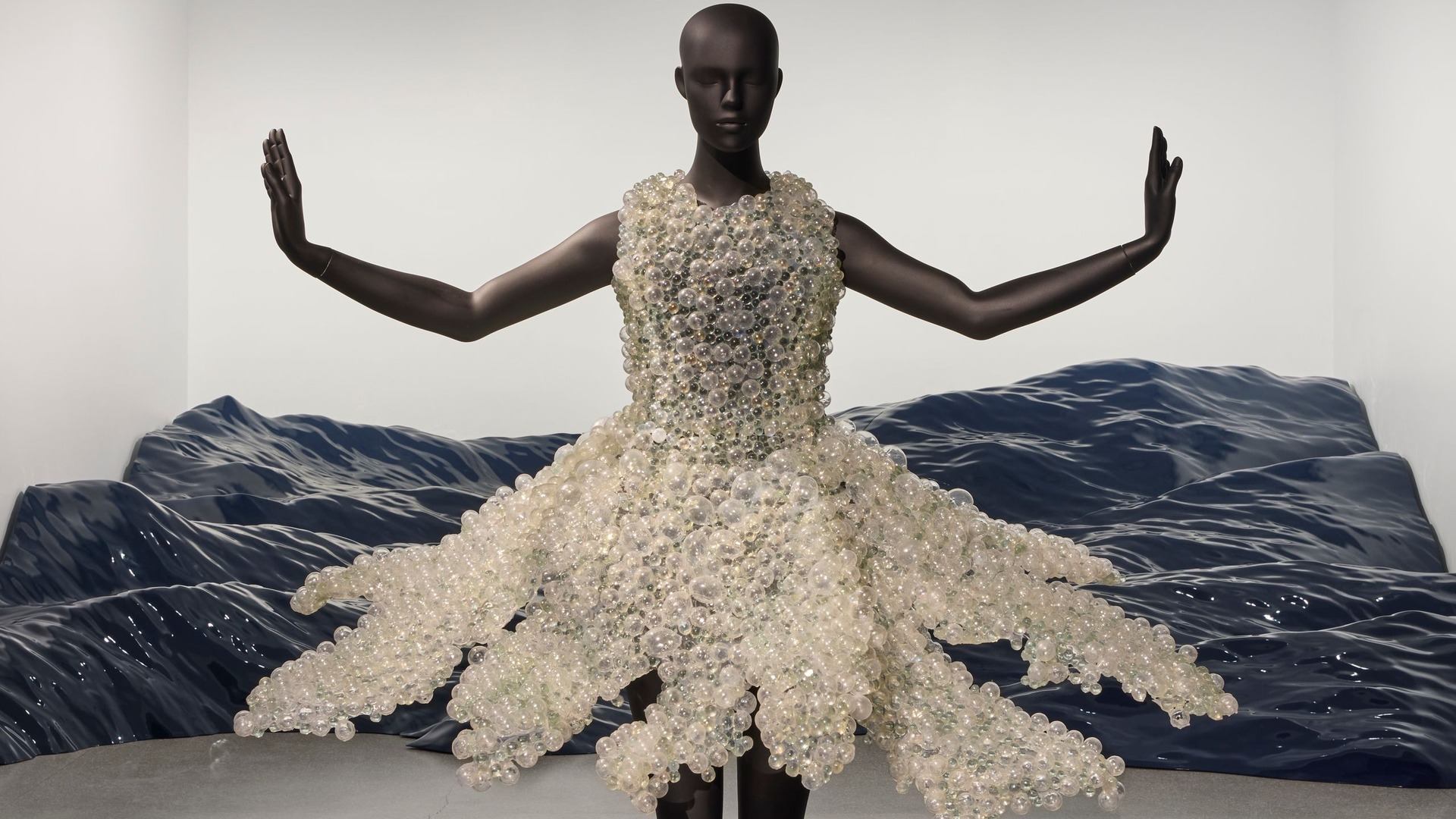
Borrelli-Persson reports that the first piece visitors encounter is van Herpen's 2016 bubble dress—a precursor to a 2026 iteration that emitted blown bubbles and went viral when Eileen Gu wore an Iris van Herpen x A.A.Murakami dress to the 2026 Met Gala. The Brooklyn Museum presentation, organized with Matthew Yokobosky, senior curator of fashion and material culture, and curatorial assistant Imani Williford, adapts rather than clones the Paris original. The museum's own overview stresses biomimicry, fractal geometry, mathematics, and neuroscience translated into sculptural gowns; accompanying works by Philip Beesley, Rogan Brown, Casey Curran, Kim Keever, Nick Knight, and others sit in dialogue with the clothes. A soundscape by composer Salvador Breed and rare archival materials push the show toward multisensory experience rather than static mannequin rows.
Eleven sections from water to cosmos
Borrelli-Persson describes immersion across eleven themed sections choreographed from micro to macro—Yokobosky notes it begins with the blue of water and ends with the blue of the cosmos. Section titles and designer quotes in Vogue map the journey: Water and Dreams; Sensory Sea Life; Forces Behind the Forms; Atelier; Synesthesia; Skeletal Embodiment; Mythology of Fear; Growth Systems; Cabinet of Curiosities; Cosmic Bloom; New Nature. Along the way, a living dress made of bioluminescent algae sits under glass and mist; mechanized garments move; microscopes invite material peering; videos unfurl from dress forms in the Atelier room. Van Herpen told Vogue she plans to make a dress in public during the run—an interactive handwork counterweight to fashion's speed myth.
Collaboration over marketing capsules
On a walkthrough, van Herpen told Borrelli-Persson that many fashion collaborations are marketing driven, while hers try to find new materials, new ways of making, and sustainability that changes how the studio works. "When fashion stays within its own bubble, it's not responding to the world," she said—language Vogue rightly put in the headline. Process, she argued, can matter more than results; working with scientists, artists, and architects shares knowledge. That stance places Sculpting the Senses beside—not identical to—other 2026 garment-and-art pairings Borrelli-Persson flags, including The Museum at FIT's Art X Fashion and The Met's Costume Art. Related Cover Issue culture reading: Tremaine Emory's Denim Tears SCAD exhibition coverage at https://thecoverissue.com/tremaine-emory-denim-tears-scad-museum-exhibition-2026 and Sabyasachi's Met-facing Bengal Byzantine Broadway chapter at https://thecoverissue.com/sabyasachi-bengal-byzantine-broadway-met-nyfw-2026.
Celebrity muses without turning the show into a wax museum
Borrelli-Persson notes pop-culture anchors: Beyoncé lent a Renaissance tour dress; Grimes's 2021 Met Gala look appears; a Mother Mary costume made for Anne Hathaway is on view. A wall of muse photographs may feel self-serving, she writes, but reads as a blip inside a career about connections and movement. The Brooklyn Museum list of wearers—Beyoncé, Björk, Cate Blanchett, Miley Cyrus, Lady Gaga, Ariana Grande—explains why the exhibition photographs so well for fashion-lifestyle audiences without requiring invented backstage drama.
Why it still matters in September–December 2026
Timed tickets remain the access rule; Member Mornings, pop-up talks, and Sculpting the (Un)Spoken performances populate the fall calendar on the museum site. For fashion students and street-style photographers landing in New York after London Fashion Week fatigue, the show offers a different pace: couture as research instrument. The Art Newspaper's May preview similarly stressed the boundary-blurring mix of fashion, art, science, technology, and natural history—useful corroboration that this is not a clothes-only retrospective.
How to visit like an editor
Start at the bubble dress threshold, then track the water-to-cosmos color story Yokobosky describes. Spend real minutes in Atelier videos before rushing to celebrity loans. Photograph installations with quiet edges—no need for illustrated overlays when the garments already look like sculpture. Our cover pulls a real On White Wall / Brooklyn Museum installation frame of a crystalline bubble dress against wave forms: photographic proof that museum fashion can still front a magazine homepage.
Iris van Herpen: Sculpting the Senses remains one of 2026's essential fashion-culture pilgrimages through 6 December. Sourced via the Brooklyn Museum, Vogue, and The Art Newspaper, it argues—through 140-plus looks and cross-disciplinary loans—that couture responds best when it leaves its own bubble.
Tickets, timing, and fall programming
The Brooklyn Museum requires timed tickets; September and October calendars listed on the museum site include Art History Happy Hour, Member Mornings, Fall Fête, pop-up talks, stroller tours, and multi-day Sculpting the (Un)Spoken participatory performances with the designer. Visit planning is part of the culture story: this is not a one-weekend pop-up. Through 6 December 2026, Iris van Herpen Brooklyn Museum remains a living exhibition with kinetic garments and public making—rarer than a static couture greatest-hits tour.
What fashion media should take from the show
Borrelli-Persson's closing argument lands in an AI year: the body stays central to humanity, nature remains a greater artist than any machine, and van Herpen's darker Mythology of Fear section still chooses collaboration and symbolism over competition—language the designer ties to nature itself. Cover Issue's job is not to flatten that into a slogan but to send readers to Brooklyn with accurate dates, section maps, and the reminder that more than 140 looks are waiting past the bubble-dress threshold.