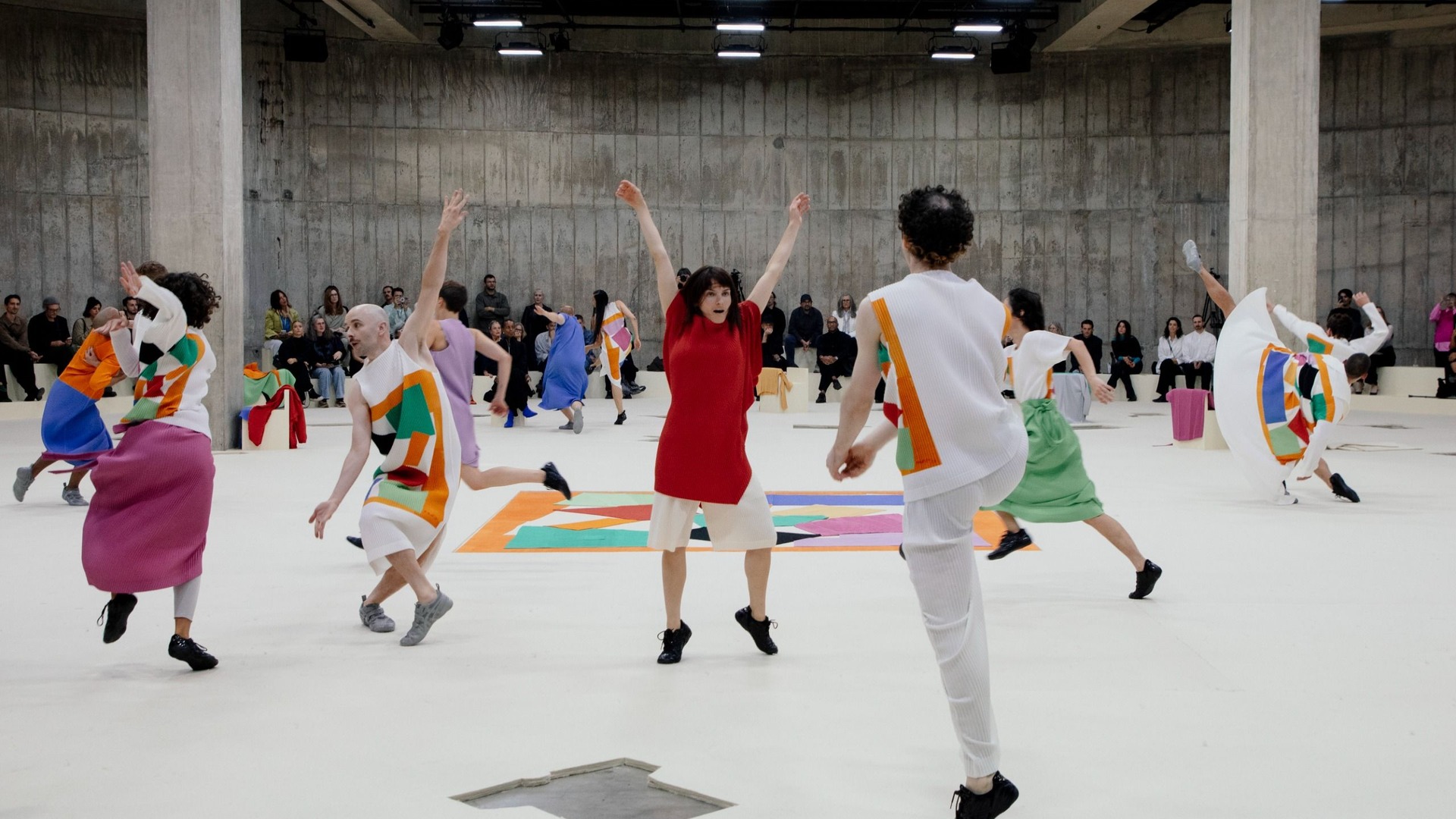
Homme Plissé Issey Miyake for Tate is the rare museum collaboration that treats a painting as a pattern for movement rather than a print dropped onto a tote. Tate’s press release dated 17 September 2026 announces a capsule inspired by Henri Matisse’s The Snail (1953), one of the most iconic works in Tate’s collection, translating the cut-out’s bold colour and sense of movement into pleated clothing and accessories. Wallpaper*’s Reeme Idris, publishing 18 September 2026, reports the second Open Studio staged at Tate Modern earlier that week with Studio Dennis Vanderbroeck and Dresden Frankfurt Dance Company. For Cover Issue’s culture desk, this is the fashion-meets-museum story of the hour—sourced, specific, and free of invented scandal.
Read Tate for official capsule contents, availability dates, and institutional quotes; read Wallpaper* for the design-team process, set design, and how garments literally reconstituted The Snail on the Tank floor. Do not invent ticket prices beyond what outlets state, private drama, or unsourced sales figures.
The collaboration also clarifies what “culture” means on Cover Issue this month: not a vague moodboard, but a dated institutional drop with a free permanent-collection artwork on one side of the Turbine Hall story and a Terrace Shop capsule on the other. Tate’s merchandise head and the Homme Plissé design team both speak on record in the press materials Wallpaper* and Tate published—enough primary voice to write without inventing atelier mythology.
From Nice cut-outs to Bankside tanks
Wallpaper* reminds readers that Matisse made The Snail in Nice in 1953 from his bed: assistants painted sheets in gouache; he cut or tore shapes; he directed pinning until satisfied; only then were pieces pasted down. The finished work is close to three metres square, arranged in a loose spiral recalling the unrolling he noticed while drawing a snail. When the Homme Plissé design team stood in front of it at Tate Modern last year, Wallpaper* reports, its size surprised them—they describe vibrancy as if pieces are still moving, dynamic and light, ready to break out from the frame. That reaction became the Open Studio idea: at this scale, why not turn each cut-out into a garment?
Tate notes Matisse found the cut-out technique liberating—drawing straight into the colour—and quotes the familiar scissors line about becoming aware of an unrolling and finding an image purified of the shell. Attribute biography and quotes to Tate’s notes and Wallpaper*’s reporting; Cover Issue does not invent additional Matisse diary entries.
Open Studio: One One One, white felt, and a living collage
Open Studio began in 2025, Wallpaper* explains, when Homme Plissé stepped off the Paris show calendar to present in places the brand had never been—first at Villa Medicea della Petraia during Pitti Uomo. Tate got in touch as the team considered where to go next; the museum’s history of designer collaborations and a single-artwork brief suited a format about opening a way of making. On 16 September, Tate states, the collection was unveiled in the Tanks with Dresden Frankfurt Dance Company. Performers revealed pleated garments inspired by Matisse’s cut-out forms through One One One—live improvised encounters between individual dancers and spectators—culminating in a large-scale composition of pleated pieces inspired by The Snail.
Wallpaper* details the scenography: Vanderbroeck covered the south tank floor in white felt cut into flat shapes laid flush, garments beneath; dancers lifted shapes away between sessions of Ioannis Mandafounis’s One One One until the whole Snail was uncovered at the centre—every Matisse shape made of a pleated garment laid flat—before changing into the capsule to finish. Vanderbroeck’s line, reported by Wallpaper*, captures the arc: starting flat, being worn, then being left behind. Attribute set mechanics and dancer methodology to Wallpaper* and Tate’s DFDC notes.
The capsule: snail pleats, palette tops, bag, scarf
Tate lists a ten-piece capsule: button-front pleated cardigan, sleeveless tunic, short-sleeved T-shirt, long-sleeved pleated top in a range of colours, plus a pleated crossbody bag and diamond-shaped scarf. Printed series carry blocks of orange, lilac, cobalt and green on white pleated jersey, Wallpaper* adds; palette tops come in white, black, orange, emerald green and purple per Tate. Elizabeth Lovatt, Head of Merchandise at Tate, says Matisse’s The Snail is an extraordinary expression of colour, movement and creative freedom, so it feels fitting to see it reimagined through Homme Plissé’s approach—bringing art, fashion and movement together. The design team, Tate quotes, was driven by a simple bold idea: animate each paper cut-out by translating it into a garment.
Availability is dated and specific: launches 17 September 2026 for a limited time at Tate Modern’s Terrace Shop and shop.tate.org.uk; from January 2027, selected Issey Miyake stores stocking Homme Plissé in Tokyo, Osaka and London. Wallpaper* confirms the same calendar. Cover Issue reports those dates as published—not as a sales forecast.
Why this collaboration matters now
Beside Cover Issue’s earlier Barbour × Saatchi tartan culture piece, Homme Plissé × Tate is the museum-fashion twin for September 2026 London: one heritage outdoor brand in a gallery frame, one pleating house animating a permanent-collection masterpiece. Wallpaper* notes Homme Plissé previously worked with Ronan Bouroullec’s drawings printed across garments; here the garments themselves assemble into the artwork when laid flat. That distinction—print versus living collage—is the culture angle worth keeping clear in SEO and social packaging.
What to watch next
Watch how visitors move between the free permanent display of The Snail and the Terrace Shop capsule—and whether January 2027 Tokyo/Osaka/London stock keeps the Matisse palette circulating past LFW week. For now, the sourced story is complete: Homme Plissé Issey Miyake for Tate turns cut-outs into pleats you can wear, dance, and leave on a museum floor.
For London visitors during Fashion Week week, the practical culture itinerary writes itself from the press materials: see The Snail on free permanent display, then check Tate Modern’s Terrace Shop for Homme Plissé Issey Miyake for Tate while the limited window holds, knowing January 2027 brings Tokyo, Osaka and London store stock. Wallpaper*’s process reporting—tracing the painting, building the tank with Vanderbroeck, uncovering garments as collage—gives you language for social captions that stay accurate. That is the standard Cover Issue wants for CULTURE pieces: museum-grade sourcing, fashion-grade wearability, zero invented lore.