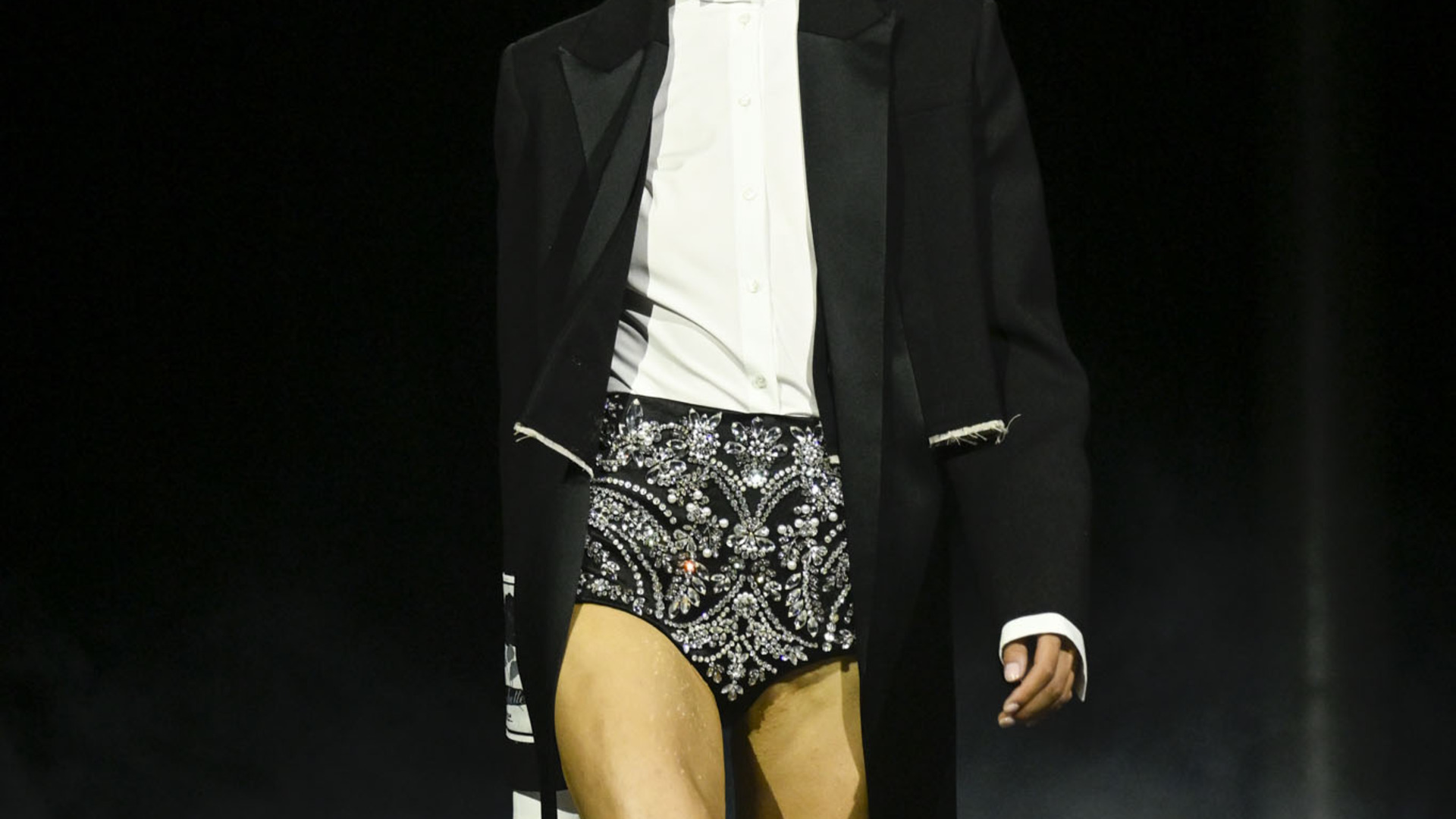
Erdem SS27 did not treat masculine and feminine as a polite mix-and-match exercise. On Sunday afternoon at London Fashion Week, Erdem Moralıoğlu staged a collection that WWD’s Miles Socha called a “humdinger,” mashing showgirl feathers, boudoir lingerie, and sparkly panties against high-collared Edwardian shirts, tuxedo jackets, and mannish woolen coats. The Impression’s Angela Baidoo frames the same season through the extraordinary life of aerialist Barbette—finding in a nearly century-old story of performance, gender, and transformation an unexpectedly urgent reflection of the present. For Cover Issue’s runway desk, Erdem SS27 at the Roundhouse is the Barbette brief made wearable: androgyny in the purest sense, clothes that refuse to pick a side, and a London room chosen for spectacle.
Barbette as muse, not costume party
Socha places Moralıoğlu’s historical leanings in context: the designer has a penchant for gender-bending figures, and this season settled on Barbette—a Texas-born man who became an avant-garde sensation in 1920s Paris as a curly-haired trapeze artist in a sparkly bra and feathery skirt. Baidoo adds the archival depth: photographs of aerialists, Man Ray’s studies, feathers, lingerie, and period ephemera surrounding Vander Clyde Broadway’s stage name. Barbette was a muse to Jean Cocteau and a sitter for Man Ray; Socha notes that Moralıoğlu’s backstage mood board also showed Barbette in a gangster-worthy double-breasted suit and fedora. That dual image is the collection’s engine. Moralıoğlu told Socha’s backstage scrum, “It was all about the tension between male and female,” and “androgyny in the purest sense.” Baidoo records him staring at “that duality” all season—not as someone trying to be a woman or a man, but as androgyny held in one body.
Roundhouse drama, dry ice, and bare legs
Baidoo reports that Moralıoğlu chose London’s Roundhouse intentionally, finding in its circular architecture and history as a performance space a home for clothes rooted in a performer who made the body into spectacle. Socha’s WWD review describes the staging as drama to spare: models storming out in crystal-studded bodysuits and soigné tailoring, parting dry ice drifting across the floor in a pitch-black space. (WWD’s copy names a Camden concert venue as the Roadhouse; The Impression and Cover Issue’s locked brief follow the Roundhouse reading—attribute venue language carefully and do not invent a venue feud.) The bare-legged silhouettes Socha flags matter: Moralıoğlu said he relished topping them with billowing Army green parkas, denim duster coats, and handsome dinner jackets with scarf-like lapels. Cropped gray V-neck sweaters and cardigans trimmed with sparkly embroideries stood out, Socha writes, as immediate impulse purchases.
Showgirl feathers versus tuxedo wool
If you only remember feathers, you missed half the argument. Socha’s review keeps the feminine victory lap vivid—gorgeous florals dissolving into fringe; grandiose bathrobe-like coats with fluffy feathered trims; plunging lace slipdresses with tiered ruffles worn over satin bra tops; gossamer tulle numbers encrusted with crystals or dangling fabric flowers—while insisting the mash-up with Edwardian shirts and tuxedo jackets is the point. Baidoo describes Moralıoğlu beginning with explicitly feminine garments—bras, briefs, lingerie—and placing them against masculine weight: waxed cotton outerwear meeting tiny pants; French jacquards spliced against utilitarian surfaces; underwear’s intimacy encountering outerwear’s protection. Neither side is allowed to completely overwhelm the other. Proportion shifts too: extremely abbreviated clothes change how the body reads; sculptural 1920s echoes get distorted, shortened, layered, and pushed into a different context. That is research talking through clothes, not Cover Issue inventing a manifesto.
Why Barbette still feels urgent
Baidoo’s interview is careful about relevance without slogans. Almost a century separates Barbette’s Paris from Moralıoğlu’s studio, yet questions of gender, self-invention, and the freedom to occupy space between prescribed identities have hardly receded. Moralıoğlu told Baidoo it felt interesting to explore a subject in America as well—“that idea of gender and in this time that we live in, I found it very urgently relevant.” Socha closes with Moralıoğlu noting that Barbette disappeared into obscurity as quickly as he emerged, though his combination of glamour and athleticism still inspires. Stay inside those sourced frames: no invented family histories, no fabricated Cocteau anecdotes beyond what WWD and The Impression report.
How to read the photographs without flattening them
Shoppers and editors decoding Erdem SS27 runway frames should look for the tells both outlets circle. From Socha: crystal-studded bodysuits against soigné tailoring; bare legs under parkas and denim dusters; sparkly-trimmed sweaters that want to walk out of Fashion Week into a cart. From Baidoo: feathers constructed as skirts against harder pragmatic elements; lingerie exposed beside protective outerwear; abbreviated proportions that make the architecture of a look feel renegotiated. The collection’s character, Baidoo argues, lives in friction—masculine making feminine feel different; delicacy changing against utility; exposure becoming more provocative when balanced by protection. Aerialism becomes metaphor without needing Cover Issue to invent circus metaphors: balance as an active state, not stillness.
Joy, not heaviness
Baidoo repeatedly returns to pleasure in Moralıoğlu’s telling—the joy of discovering an image, colliding fabrics that should not belong together, watching a new proportion emerge. “We so enjoyed making it,” he says. “It felt like a kind of joyful moment.” That joy matters for how the collection lands on readers: Barbette is not presented as a lecture. Fashion often talks about reconciling opposites; Baidoo’s reading is that Moralıoğlu prefers to leave them visible. Masculine does not have to disappear for feminine to emerge. Strength need not cancel delicacy.
Watch how Erdem SS27’s Barbette androgyny translates from Roundhouse dry ice into spring retail edits—whether feathered coats and lace slips over bra tops stick past London’s applause, and whether the parkas-and-panties tension Socha celebrated becomes a commercial signature. For now, the sourced runway record is clear: Erdem Moralıoğlu made androgyny feel athletic, glamorous, and urgently contemporary without asking clothes to pick a single gender destination.