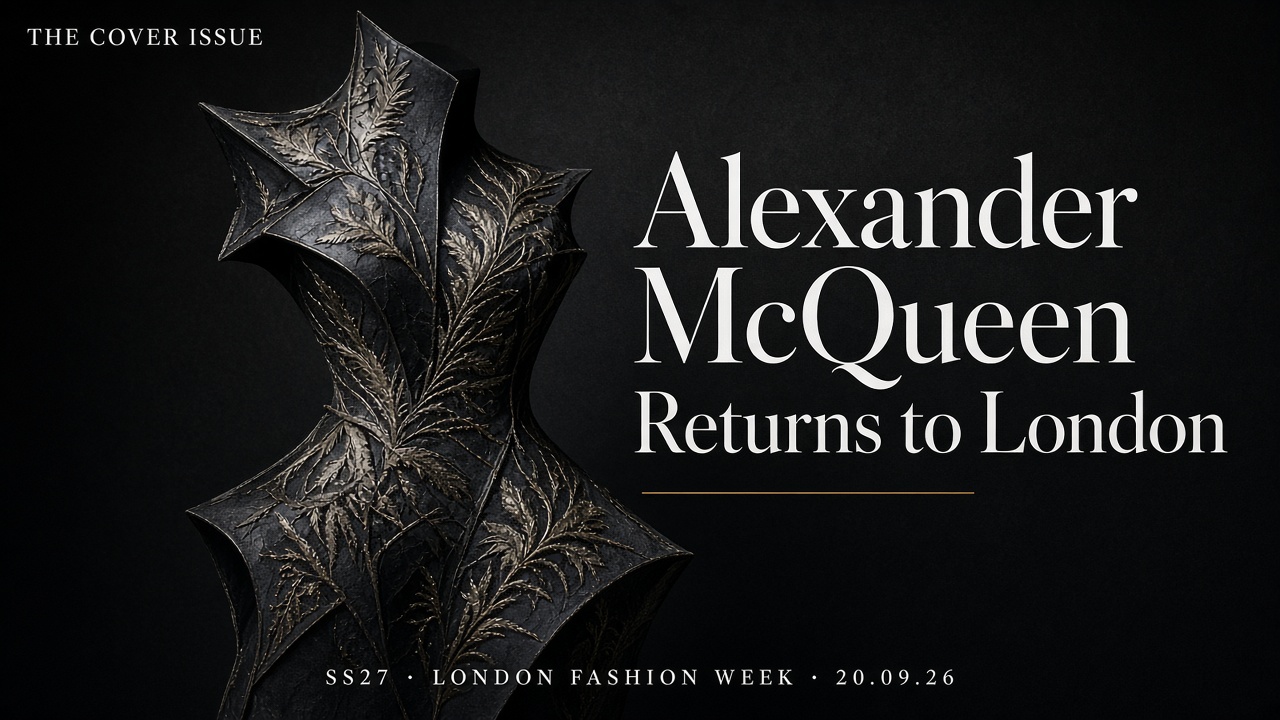
Tonight in London, Alexander McQueen steps back onto the official Fashion Week calendar for the first time since February 2001. Creative director Seán McGirr will present the house’s spring/summer 2027 collection on September 20—his first McQueen show in the city that forged both the brand and his own design education. For anyone watching London Fashion Week for heat, not filler, this is the slot.
McQueen usually shows in Paris. That geography shift alone is news. According to WWD, the house booked a September 20 London date months ahead, pairing womenswear and menswear with the sharp tailoring and occasion dressing that still define the label. McGirr told WWD that London “has always been at the heart of McQueen,” citing the city’s “uniquely visceral energy.” New CEO Gianfranco D’Attis framed the move as a reaffirmation of the house’s British roots and its partnership with the British Fashion Council. BFC CEO Laura Weir, also speaking to WWD, called McQueen’s return one of her earliest ambitions as CEO—a vote of confidence in “British creativity at its most fearless.”
Why this homecoming matters (and what “first since 2001” actually means)
Lee Alexander McQueen founded the brand in 1992 and built its early reputation on raw London shows before shifting to Paris. The house never fully vanished from the capital. As Vogue notes, under former creative director Sarah Burton there were notable menswear presentations at London Collections: Men, plus two off-schedule spring shows in 2022 and 2023—including memorable venues such as the Old Royal Naval College in Greenwich and an East London car-park rooftop. Tonight is different: it is the first official London Fashion Week schedule slot in a generation.
Timing is part of the story. McGirr has spent nearly three years absorbing McQueen’s codes collection by collection. In a September 19 preview with Vogue’s Luke Leitch, he said that in a house with McQueen’s legacy, learning those codes takes time—and that with SS27 he wants to “go to the next level,” synthesizing house lore with his own identity rather than replaying a single era.
What Seán McGirr is actually putting on the runway
From the Clerkenwell studio fittings Vogue previewed, expect energy over museum stillness. McGirr showed a silver hourglass dress whose jacquard surface was overlaid with drifts of metallic foliage—alloy leaves dipped in paint so the metal shifts tone—plus a section of organza at the base that lightens a look that reads almost armor-like above. He called it a “quintessential McQueen silhouette,” linking its Hitchcock proportions to the house’s late-2000s period, and stressed embroidery on already-decorative surfaces: nothing should feel “too solid or static.”
That armor-adjacent fierceness—sharp shoulders, cinched waists, metal that moves—is the visual headline to watch live (or in the first look dumps). Pair it with the house’s other signatures: razor tailoring, high-drama evening pieces, and the tension between hardness and float that McQueen audiences expect. McGirr’s own through-line, per Vogue, is forward motion. He invoked the founder’s 2010 warning against rehashing “the good, the bad, and the ugly,” and answered with his own rule: you can’t go back; you have to move forward.
Shaun Leane and the London collaborators circling back
One of the evening’s most resonant details is not a dress but a reunion. Jeweler and sculptor Shaun Leane—one of Alexander McQueen’s closest early collaborators—has contributed to tomorrow’s show, according to Vogue. First-generation McQueen partners returning as McGirr stages a London homecoming is the kind of continuity editors will clock in jewelry close-ups: sculptural metal, body-conscious pieces, anything that reads as armor jewelry rather than polite sparkle.
McGirr’s London biography makes the geography feel earned rather than PR. He arrived from Ireland at 17, found his circle at Central Saint Martins—“a bunch of weirdos,” he told Vogue—lived on a Haggerston council estate, later carved a sewing studio out of a derelict former care home in Camden, and haunted museums by day and clubs by night. At the National Gallery he became obsessed with Piero della Francesca’s The Baptism of Christ, staring at it for long stretches. Expect those formative London references—church light, club grit, museum craft—to surface in silhouette and embellishment even if they never appear as literal motifs.
What to watch tonight: a practical checklist
The official-calendar optics. Compare the production scale and front row to McQueen’s recent Paris shows—and to Burton’s off-schedule London experiments. Is this a full house statement or a leaner, freer London edit?Armor vs. air. Track how many looks balance hard metal or structure on top with organza, soft skirts, or open hems below—the hourglass dress McGirr previewed is the template.Metallic foliage and surface-on-surface embroidery. Not flat sparkle: layered, painted, shifting alloys that move under lights.Shaun Leane jewelry moments. Neck, ear, and hand pieces that read sculptural rather than bridal.Menswear in the mix. WWD flagged both women’s and men’s in the London show—watch how McGirr’s sharpness translates across the two.McGirr’s “free London” thesis. He told Vogue, “London is about being free.” If the show feels riskier or less polished than Paris McQueen, that may be the point.
How this fits McQueen’s wider London push
The runway return sits beside other London moves. WWD reported that McQueen is leaving its 27 Old Bond Street store (occupied since 2019) for a smaller unit on the same street this fall, with refreshed interiors and the full assortment—part of a broader restructuring. Showing on-schedule while resizing retail in Mayfair is a double signal: the house wants London’s cultural heat without pretending the business case is static.
For fashion week watchers, the practical takeaway is simple. Tune in for silhouettes that cut like armor, metal that behaves like embroidery, and jewelry that remembers the house’s earliest collaborators. McGirr has spent three years studying McQueen’s periods in public. Tonight he claims London as the place to stop studying and start synthesizing—on the same official calendar that once launched the house into the world.